



Official PyTorch implementation for "FuXi-Linear: Unleashing the Power of Linear Attention in Long-term Time-aware Sequential Recommendation".
FuXi-Linear brings linear-complexity modeling to long-term time-aware sequential recommendation. It separates semantic, temporal, and positional signals through a FuXi-Linear block with a Temporal Retention Channel and a Linear Positional Channel, enabling long-sequence experiments on KuaiRand-27K, KuaiRec, and MovieLens-20M.
1. Paper
Yufei Ye, Wei Guo, Hao Wang, Luankang Zhang, Heng Chang, Hong Zhu, Yuyang Ye, Yong Liu, Defu Lian, and Enhong Chen. FuXi-Linear: Unleashing the Power of Linear Attention in Long-term Time-aware Sequential Recommendation. arXiv:2602.23671, 2026.
Paper / PDF / Project Page / Code / Citation
The paper argues that conventional attention-based recommenders struggle with thousand-length user sequences because of quadratic cost and coupled temporal/semantic signals. FuXi-Linear introduces temporal retention and linear positional modeling to retain recommendation quality while improving long-sequence efficiency.
2. Highlights
- Uses a Temporal Retention Channel to capture period-aware temporal information without mixing it directly with semantic attention.
- Adds a Linear Positional Channel to restore positional signals under linear attention.
- Supports long time-aware sequential recommendation experiments with public preprocessing scripts.
- Reports efficient long-sequence inference with competitive recommendation quality.
3. Method At A Glance
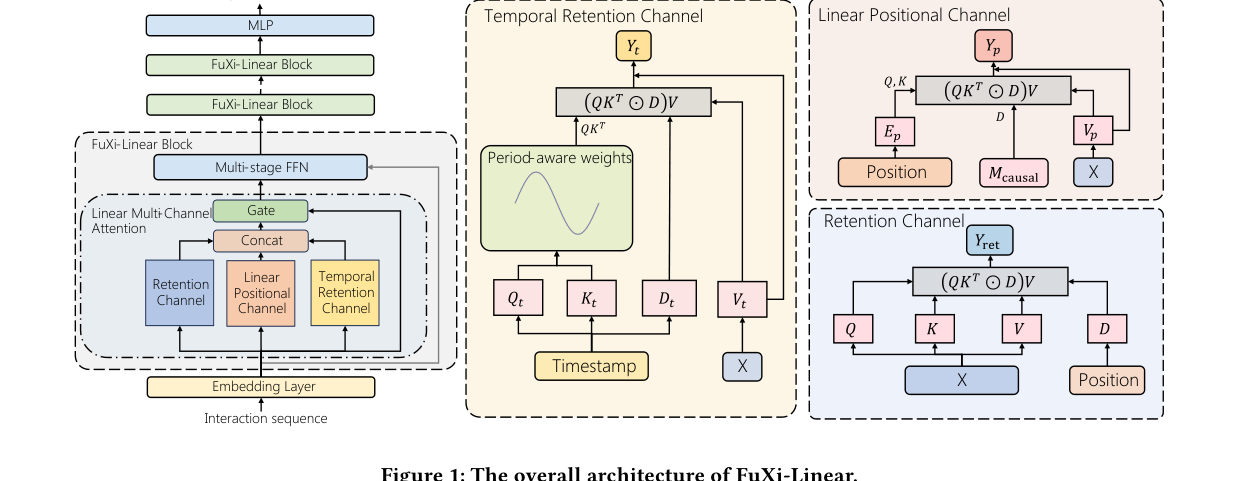
The FuXi-Linear block combines retention, linear positional, and temporal retention channels before the multi-stage feed-forward network. This design keeps linear complexity while making timestamp and position information explicit.
4. Repository Structure
.
|-- configs/                         # Gin configs for KuaiRand-27K, KuaiRec, and MovieLens-20M
|-- generative_recommenders/         # Sequential recommendation model components
|-- preprocess_*.py                  # Dataset preprocessing scripts
|-- main.py                          # Main training entry point
|-- requirements.txt                 # Runtime dependencies
`-- docs/                            # Project page and README assets
5. Installation
Install PyTorch for your CUDA environment first, then install the remaining dependencies:
pip3 install gin-config absl-py scikit-learn scipy matplotlib numpy apex hypothesis pandas fbgemm_gpu iopath6. Data / Models
Create a local tmp/ directory and download the public datasets:
Expected local layout:
tmp/
|-- kuairand-27k/
`-- kuairec/
7. Quick Start
Preprocess public datasets:
python3 preprocess_public_data.py
python3 preprocess_kuairand27k_data.py
python3 preprocess_kuairec_data.py
Run a KuaiRand-27K experiment:
CUDA_VISIBLE_DEVICES=0,1 python3 main.py \
  --gin_config_file=configs/kuairand-27k/linear-4b-l1024-b64x2.gin \
  --master_port=12345
8. Reproducing Results / Evaluation
Experiment configurations are organized under:
configs/kuairand-27k/configs/kuairec/configs/ml-20m/
Training logs are written to exps/ by default. You can inspect them with TensorBoard:
tensorboard --logdir ./exps/kuairand-27k-l1024/ --port 24001 --bind_all9. Configuration Notes
The included Gin files cover several model families and sequence-length settings. Start from the dataset-specific linear-*.gin files when reproducing FuXi-Linear, then compare against the HSTU, Mamba, SASRec, TiM4Rec, and TTT configurations included in the same folders.
10. Experimental Highlights
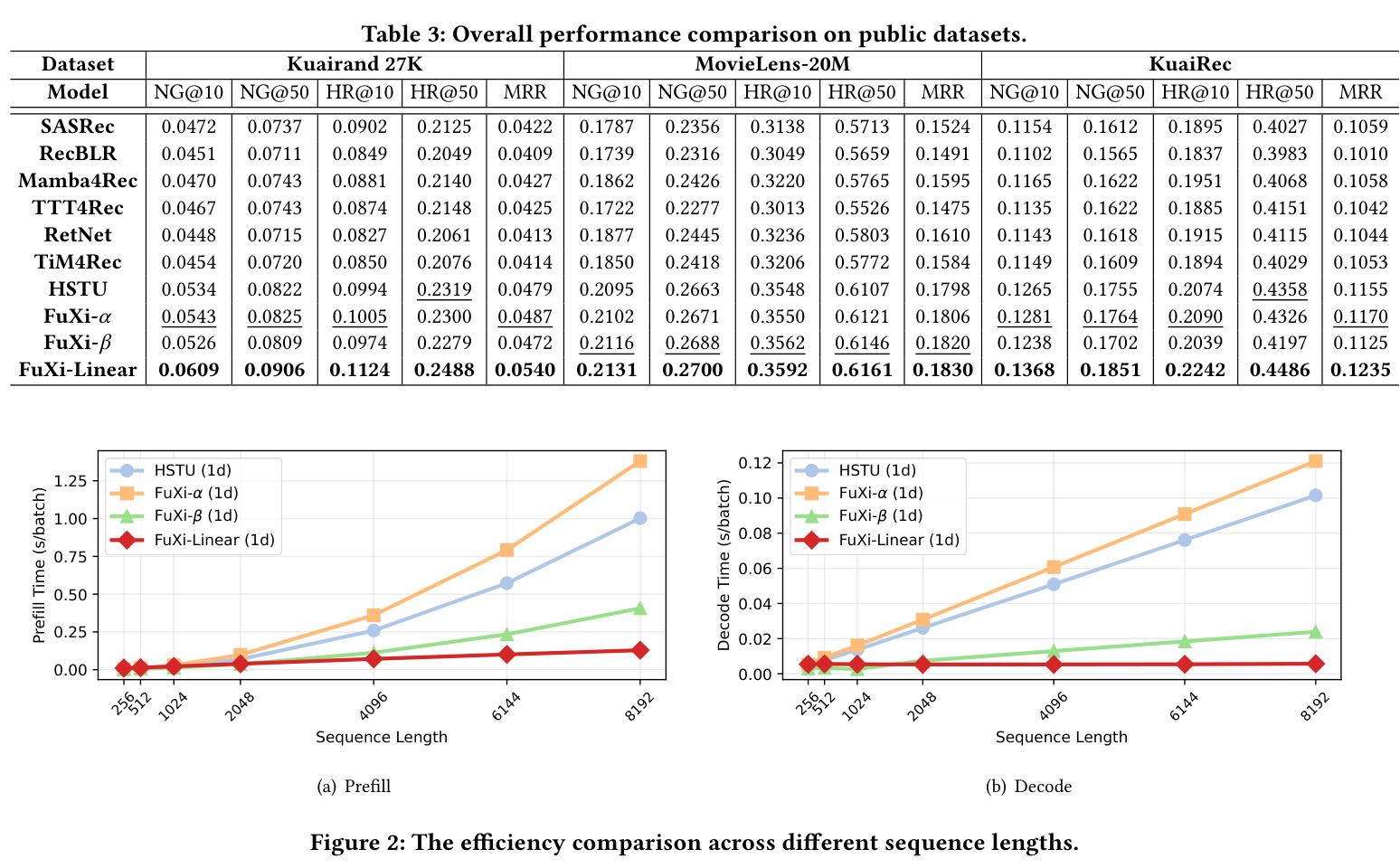
The crop above combines the paper's public-dataset comparison and sequence-length efficiency curves, showing both the accuracy gains and the prefill/decode speed advantage that motivate the concise summary below.
The reported experiments focus on long user histories where efficient attention matters most. FuXi-Linear is designed to preserve the expressive benefits of sequence modeling while reducing prefill and decoding costs in thousand-length recommendation settings.
| Finding | Paper evidence | Takeaway |
|---|---|---|
| Overall accuracy | On Kuairand-27K and KuaiRec, FuXi-Linear reports average relative gains of +9.26% NDCG@10, +7.24% NDCG@50, +9.01% HR@10, +5.11% HR@50, and +8.33% MRR. | The linear design keeps accuracy competitive in long-sequence settings. |
| Temporal channel | On Kuairand-27K, the temporal method reports NDCG@10 0.0609, HR@10 0.1124, and MRR 0.0540 with linear complexity. | Explicit temporal modeling is a main source of the gain. |
| Efficiency | The paper reports up to 10x prefill and 21x decoding speedups; at sequence length 8k, prefill is faster than FuXi-alpha, FuXi-beta, and HSTU. | The method targets deployment cost, not only offline accuracy. |
| Scaling | On Kuairand-27K, NDCG@10 / HR@10 scale from 0.0472 / 0.0881 at 188K parameters to 0.0710 / 0.1288 at 20M parameters. | The architecture preserves useful scaling behavior over larger models. |
11. Notes For Maintainers
- Keep dataset files and training artifacts out of Git history.
- Store future README/project-page figures under
docs/assets/. - When proceedings or presentation links become public, add them to the Paper section and project page.
12. Citation
@misc{ye2026fuxilinear,
  title = {FuXi-Linear: Unleashing the Power of Linear Attention in Long-term Time-aware Sequential Recommendation},
  author = {Ye, Yufei and Guo, Wei and Wang, Hao and Zhang, Luankang and Chang, Heng and Zhu, Hong and Ye, Yuyang and Liu, Yong and Lian, Defu and Chen, Enhong},
  year = {2026},
  eprint = {2602.23671},
  archivePrefix = {arXiv},
  primaryClass = {cs.IR},
  url = {https://arxiv.org/abs/2602.23671}
}
13. Contact
For paper questions, please contact:
- First author: Yufei Ye (
aboluo2003@mail.ustc.edu.cn) - Corresponding authors: Hao Wang (
wanghao3@ustc.edu.cn) and Enhong Chen (cheneh@ustc.edu.cn)
For repository issues, please open a GitHub issue in this repository.