Advanced Knowledge Question Answering
Objective and subjective chemistry QA covering terminology, concepts, quantitative analysis, and cross-modal reasoning.
A Multi-level and Fine-grained Chemical Capability Evaluation for Large Language Models
[2026-06-09] ChemEval project page, README, GitHub Pages, and repository metadata are updated for the ICLR 2026 release.
ChemEval is a fine-grained benchmark for evaluating large language models and multimodal large language models in chemistry. The benchmark targets the gap between general language ability and the chemical expertise required for literature understanding, molecular reasoning, synthesis planning, and multimodal evidence interpretation.
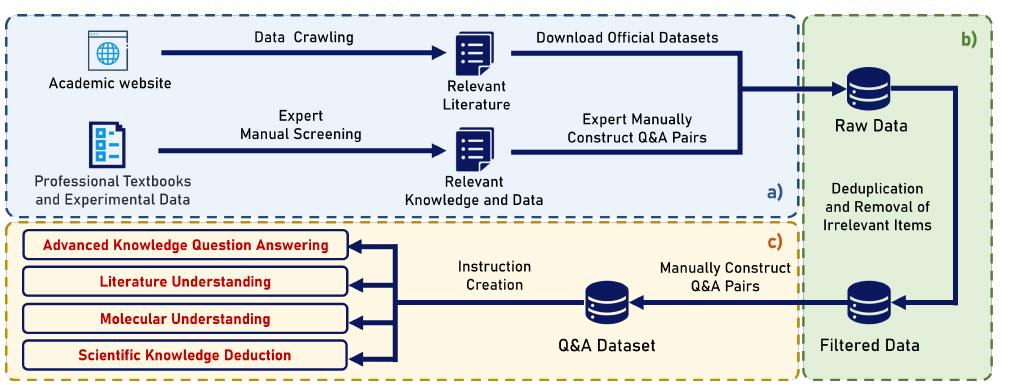
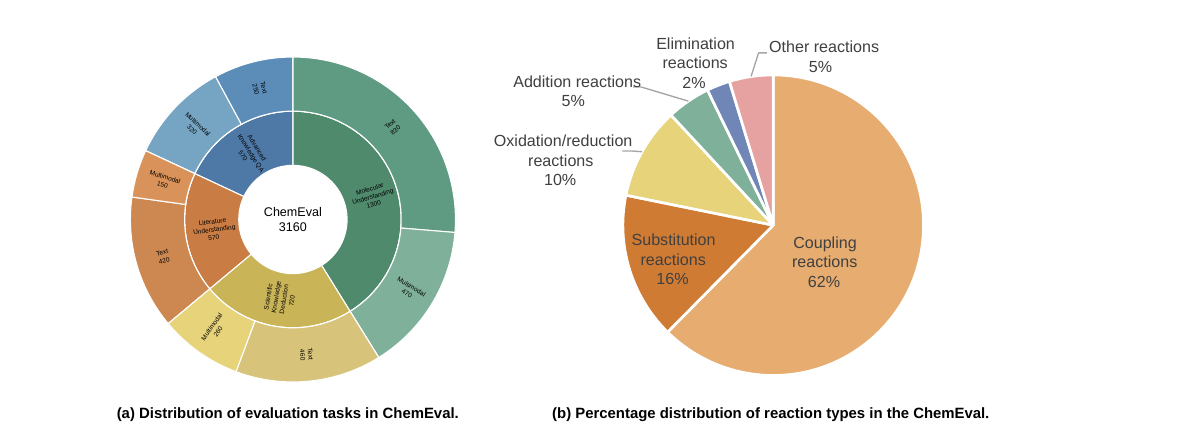
The ICLR 2026 version organizes the evaluation into 4 progressive levels, 13 capability dimensions, and 62 text and multimodal tasks. It reports 1,960 text examples and 1,200 multimodal examples, combining curated open-source datasets with expert-authored materials.
Objective and subjective chemistry QA covering terminology, concepts, quantitative analysis, and cross-modal reasoning.
Information extraction, inductive generation, and molecular name recognition from chemical literature and image data.
SMILES/IUPAC conversion, molecular property prediction, and molecular description from structures, spectra, and text.
Retrosynthesis, reaction condition recommendation, reaction outcome prediction, and mechanism analysis for chemical synthesis.
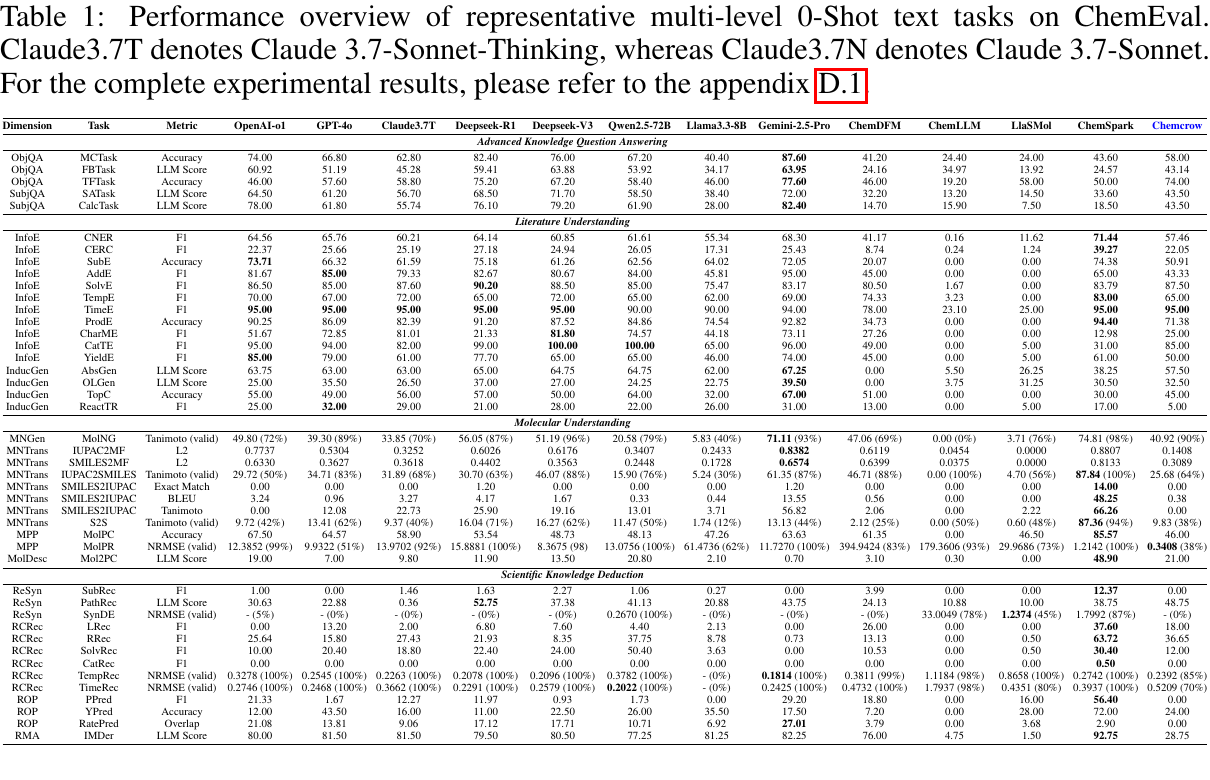
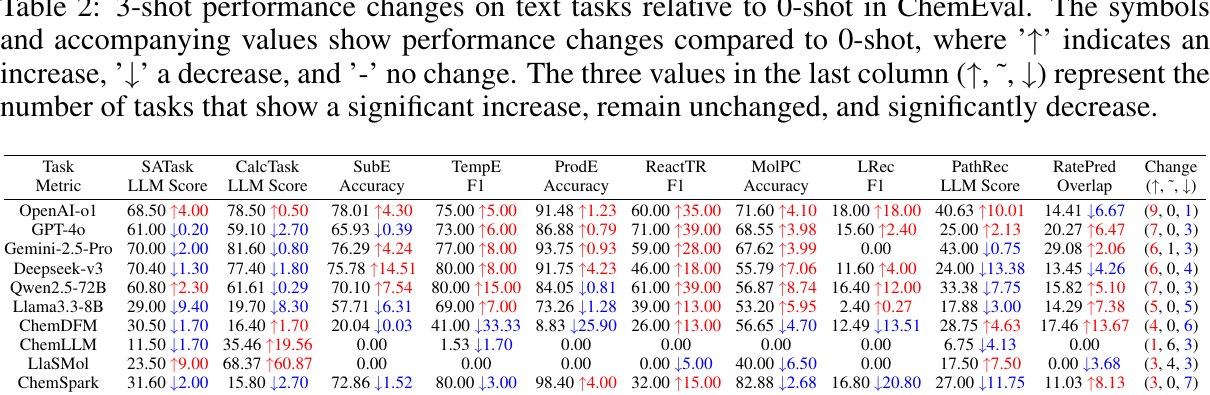
General models are strong at literature understanding and instruction following, but struggle with molecular understanding and scientific inference.
Chemistry-specialized models show advantages on terminology and molecular property tasks, but can lose broad instruction-following ability.
Multimodal chemistry tasks expose gaps in visual structure recognition and chemical knowledge application.
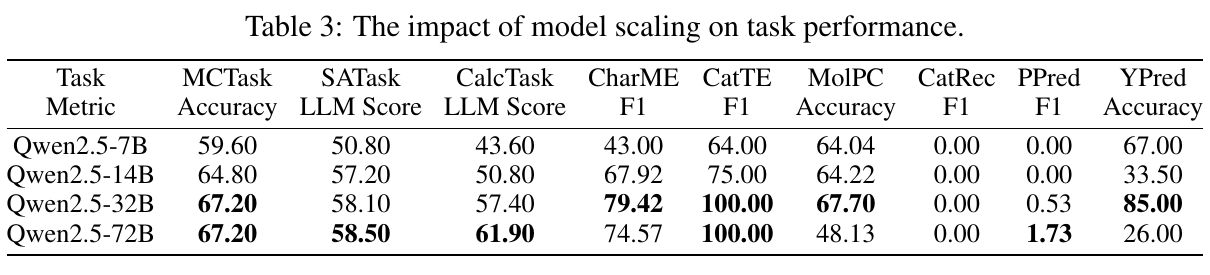
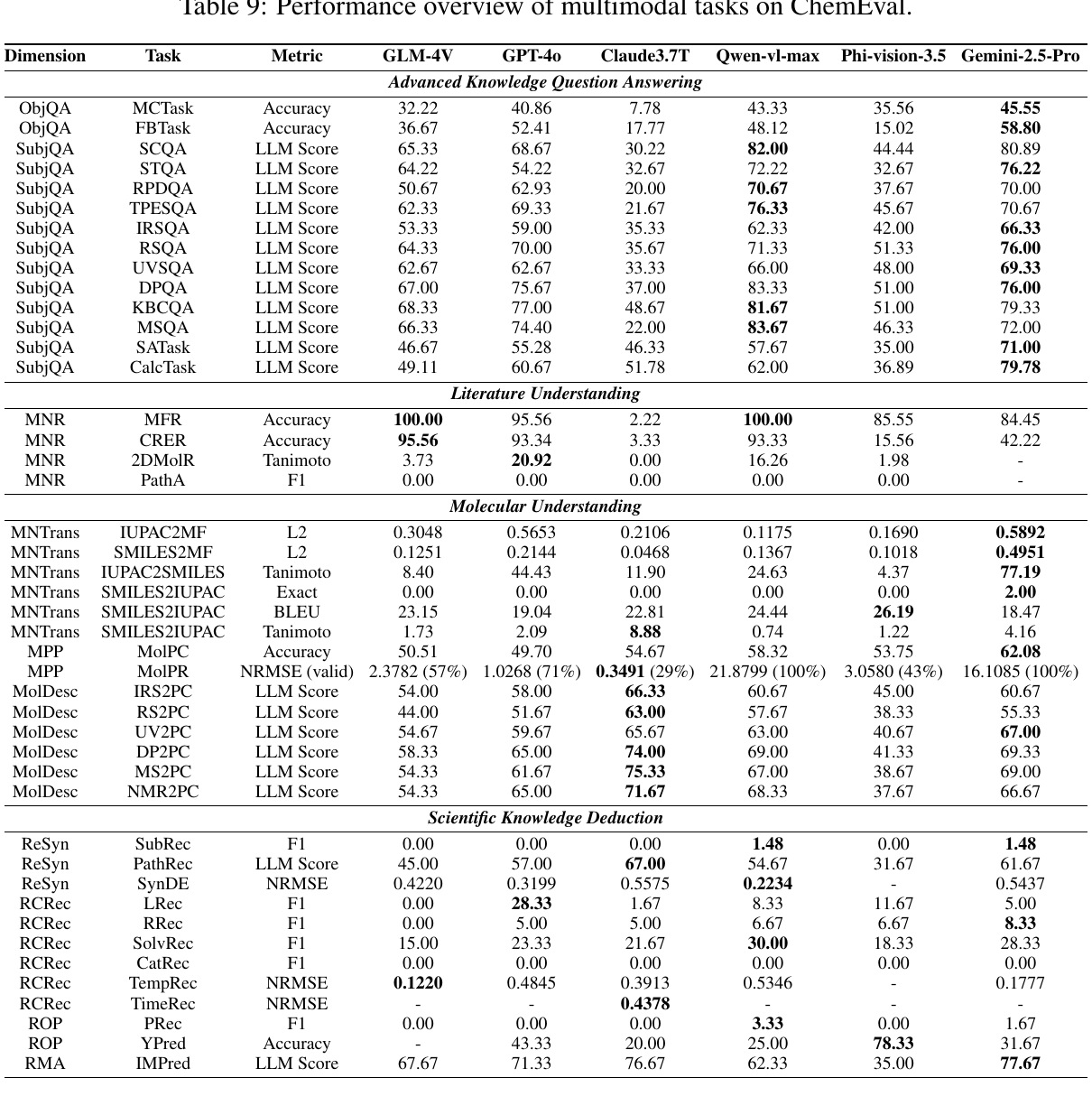
The repository provides answer extraction, LLM-based grading, and code-based metric scripts for textual and multimodal ChemEval tasks. The dataset is released on Hugging Face and the evaluation code is hosted on GitHub.
python "Textual/code evaluate/1_Split_filename.py"
python "Textual/code evaluate/2_Extract.py"
python "Textual/code evaluate/3_Evaluate.py"

python "Multimodel/3_code_evaluate/1Extract.py"
python "Multimodel/3_code_evaluate/2Evaluate.py"@inproceedings{
huang2026chemeval,
title={ChemEval: A Multi-level and Fine-grained Chemical Capability Evaluation for Large Language Models},
author={Yuqing Huang and Rongyang Zhang and Xuesong He and Xuyang Zhi and Hao Wang and Nuo Chen and Zongbo Liu and Xin Li and Feiyang Xu and Deguang Liu and Huadong Liang and Yi Li and Jian Cui and Yin Xu and Shijin Wang and Qi Liu and Defu Lian and Guiquan Liu and Enhong Chen},
booktitle={The Fourteenth International Conference on Learning Representations},
year={2026},
url={https://openreview.net/forum?id=JrqjSkEPrX}
}